 GameWave
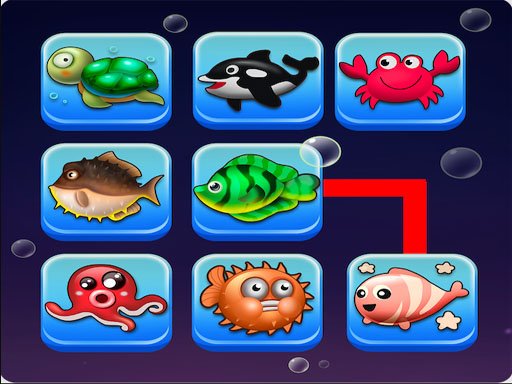
Fish Matching Puzzle Adventure keeps its rules minimal: connect identical fish with clear paths that bend at most twice. That single constraint creates the challenge, because the order you clear fish determines which routes stay open. The underwater visuals and cheerful audio suit short breaks or relaxed sessions. It is free, needs no download, and works for children and adults. The main limitation is that the description does not specify level counts or difficulty progression, so replay value depends on how much you enjoy the core matching loop.
Each board is a grid of fish icons in different colors and shapes. Your job is to find two identical fish and draw a path between them. That path cannot cross any other fish, and it can turn at most twice. When a valid connection is made, both fish vanish and you earn points. The board is cleared when every fish is gone.
The two-turn limit is the whole challenge. A pair might look connectable, but if the only clear route requires three bends, it will not work. You often need to remove other fish first to open a path. This means the order you match matters. Clearing fish from the center early tends to create more options later, while leaving edge fish for last can trap you. If no valid moves remain, the game ends.
The underwater theme runs through every fish design, and the graphics stay bright and non-threatening. Cheerful sound effects play as you match. There is no timer or pressure mechanic described, so you can study the board for as long as you like. The game runs directly in a web browser and requires no download or account.
Because the rules take seconds to learn, the game works for young children and adults alike. The strategy layer—planning which pairs to clear first—gives experienced puzzle players something to think about. Sessions can be short or long, and the game is free with no in-app purchases mentioned. It is designed for solo play, though comparing scores with others is possible.
Sign in to comment
You must be logged in before posting a review or rating.
No comments yet. Be the first to comment!











Editorial Notes